The World Is Looking Back
Tracey Chaykin and the Intimacy of Environmental Attention
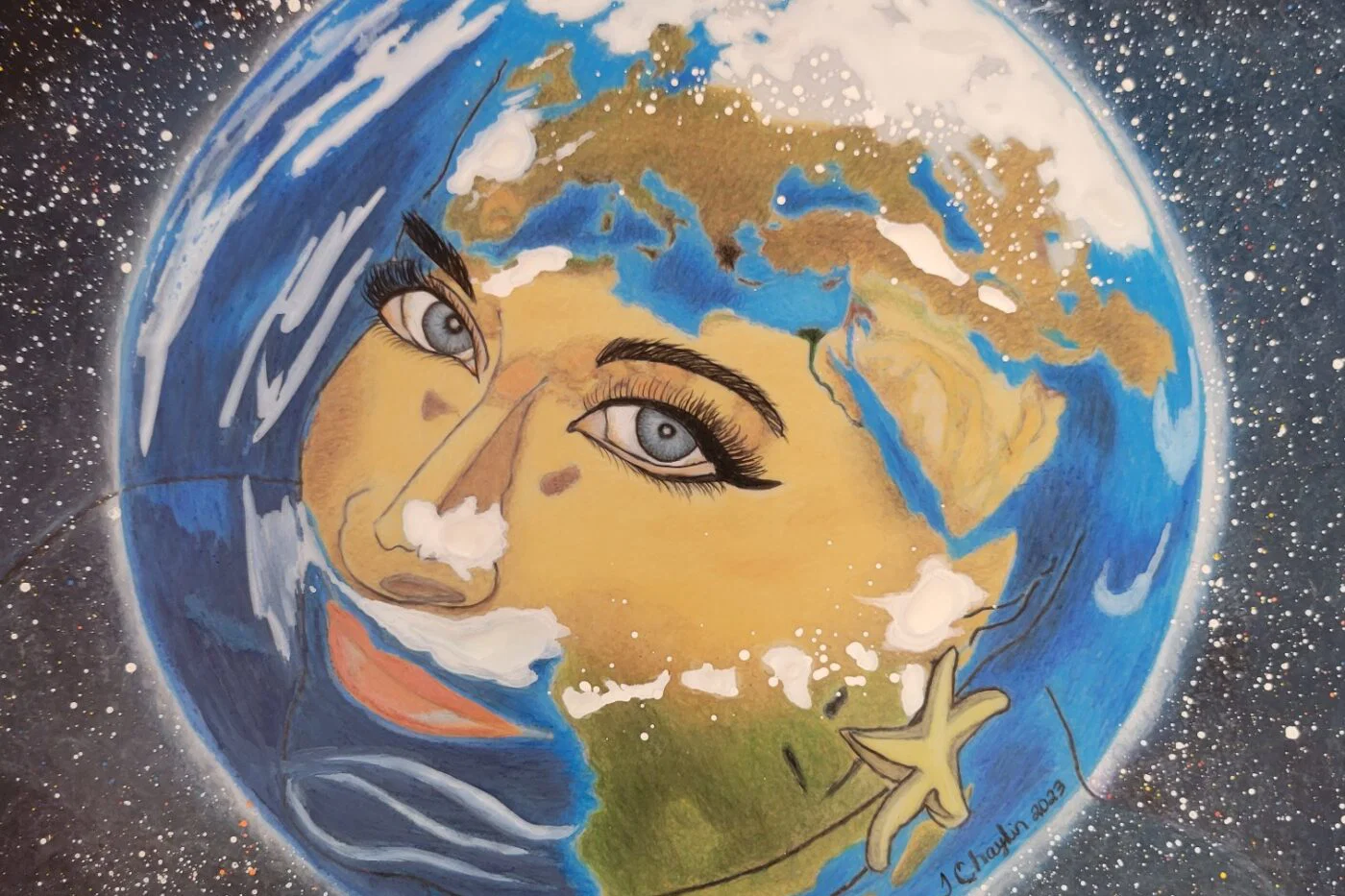
In Connected, the planet has eyes.
They look directly at us—not with accusation, exactly, but with the unmistakable force of recognition. Earth is no longer a distant blue sphere, a map, or an environmental abstraction. It has become a presence. It sees us.
Tracey Chaykin’s work begins at the moment when looking becomes reciprocal. Her images ask what happens when the natural world stops behaving like scenery and enters the relationship as a subject of its own.
This is the emotional intelligence of her environmental art. She does not begin with catastrophe. She begins with intimacy.
From Crisis to Relationship
The language of environmental crisis is often immense: rising temperatures, collapsing habitats, species loss, planetary thresholds. The scale is accurate, but it can also create distance. When everything is at stake, the mind struggles to find a place to stand.
Chaykin changes the scale of the encounter.
In Connected, continents become features of a face. Clouds move across skin. Sea and land form a living expression suspended in space. The image contains the whole planet, but its emotional impact comes from something deeply human: eye contact.
We recognize the planet first. Then the planet recognizes us.
That reversal removes the comfort of distance. Environmental concern is no longer an issue happening somewhere else. It becomes a relationship—and relationships carry responsibility.
The Power of a Returned Gaze
A face is among the fastest images the human mind can read. Before language, before analysis, we search for eyes. We look for intention, vulnerability, and response.
Chaykin uses that instinct with precision. The face in Connected does not merely decorate the globe; it changes the viewer’s role. We are no longer observers studying an object. We are participants in an encounter.
The surrounding field of stars intensifies the effect. Against the enormity of space, Earth appears both powerful and exposed: singular, radiant, and without replacement. The image gives cosmic scale a personal center.
We enter Chaykin’s images as viewers. We leave them as participants.
The Ethics of the Slow Mark
Chaykin is known for detailed colored-pencil work, sometimes combined with other media. Colored pencil is an exacting choice. It builds through pressure, layering, repetition, and patience. Color does not arrive in one sweeping gesture; it accumulates.
That process carries its own environmental metaphor.
A single mark may appear small. Repeated carefully, it creates atmosphere, depth, skin, water, and light. The finished image is evidence that small actions do not remain small when they gather.
The same is true of stewardship. Conservation is rarely one heroic act. It is a pattern: what we protect, what we refuse, what we restore, what we repeat. Chaykin’s technique makes accumulation visible.
Small is not the same as powerless.
Inside the Sanctuary
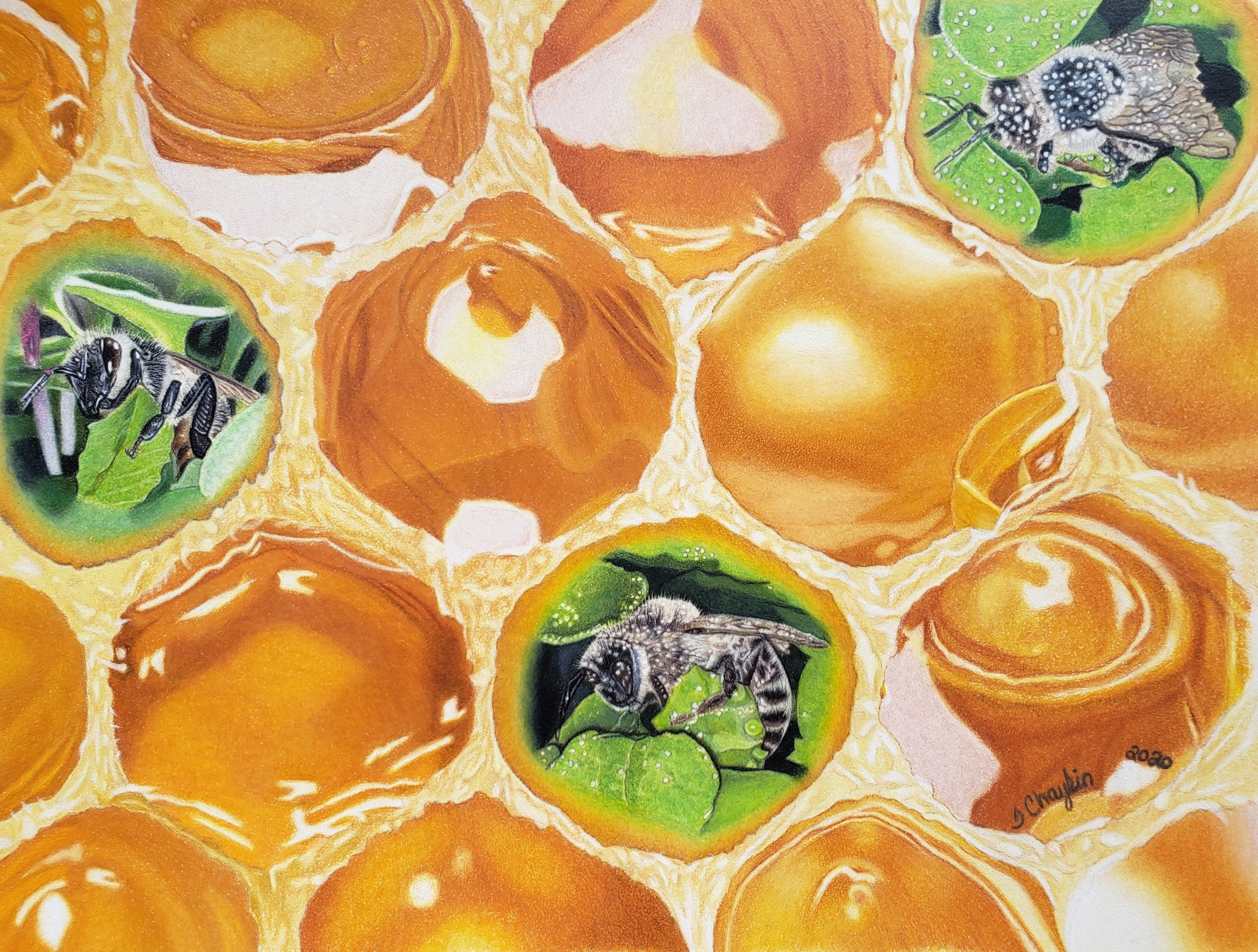
If Connected gives the planet a face, Sanctuary carries us inside one of its smallest architectures.
Honeycomb fills the composition in warm amber, cream, and gold. Some cells hold reflected light; others open onto green leaves and the finely observed bodies of bees. The geometry is orderly, but the image is alive with variation.
At first the honey feels abundant. Then the bees command attention. Their bodies are small within the field, yet the entire system depends on them. Chaykin lets beauty lead us toward interdependence.
The title matters. A sanctuary is more than a habitat. It is a place made safe. The word carries an ethical proposition: life needs spaces where it can continue without being treated as disposable.
Wonder Changes With Scale
Placed together, Connected and Sanctuary move between two scales of wonder.
One gives us a planet floating in the universe. The other gives us a bee inside a honeycomb. One appears immeasurable; the other can be held in the mind as a single, fragile life.
But the works refuse to separate them. The large exists through the small. The planetary is composed of innumerable local systems, bodies, gestures, and dependencies.
This movement in scale is psychologically important. Awe can open attention, but intimacy gives attention somewhere to land. Chaykin offers both: the sublimity of Earth and the immediacy of a pollinator.
Art, Articles, and Actions
Chaykin describes herself not only as an artist but as an environmental advocate. Her public practice connects art, articles, and actions—a phrase that makes clear that the image is not intended to be the end of the encounter.
Her training with the Climate Reality Project and her engagement with conservation reflect a belief that art can help prepare the mind for action. Not by reducing a complex issue to a slogan, but by changing what the viewer feels close to.
This distinction matters. Information can establish urgency, yet urgency alone does not always create care. Chaykin’s work builds the emotional bridge first.
We protect differently when the subject no longer feels anonymous.
Attention Comes Before Action
To draw a bee in close detail is to spend time with its structure: the translucent wings, segmented body, delicate legs, and dense pattern of hair. Such attention is not neutral. It is a form of regard.
Chaykin’s images invite the viewer into that same sustained looking. The reward is not merely technical admiration. The longer we look, the harder it becomes to treat the living world as background.
This may be one of art’s most practical forms of power. It trains attention. And attention is often the first condition of responsibility: we cannot care for what we have learned not to notice.
Her work therefore avoids the emotional paralysis that can accompany environmental imagery. Rather than presenting nature only at the moment of destruction, she shows us what remains vivid, intricate, and worthy of defense.
The Distance Disappears
Tracey Chaykin’s art does not ask us to admire nature from afar. It asks us to recognize that there is no true afar.
The atmosphere crosses the face in Connected. The bee moves through the architecture of Sanctuary. Each image dissolves the border between a world we look at and a world we belong to.
That is why Connected is the right cover image. Its gaze reaches us before explanation. On a phone screen, the vertical composition keeps the face immediate; in print, it holds the directness of a portrait. The viewer is not permitted the role of invisible spectator.
The world is looking back.
And once we feel ourselves inside its field of vision, care becomes less like an obligation imposed from outside and more like a natural response to relationship.
Sources
Artist-supplied DIXED statements and submission materials.
Tracey Chaykin: Official Website
Tracey Chaykin: About
Pacific Art League: Colored Pencil Exhibition