Nothing Is Still
Howard Harris and the Energy Beneath the Visible
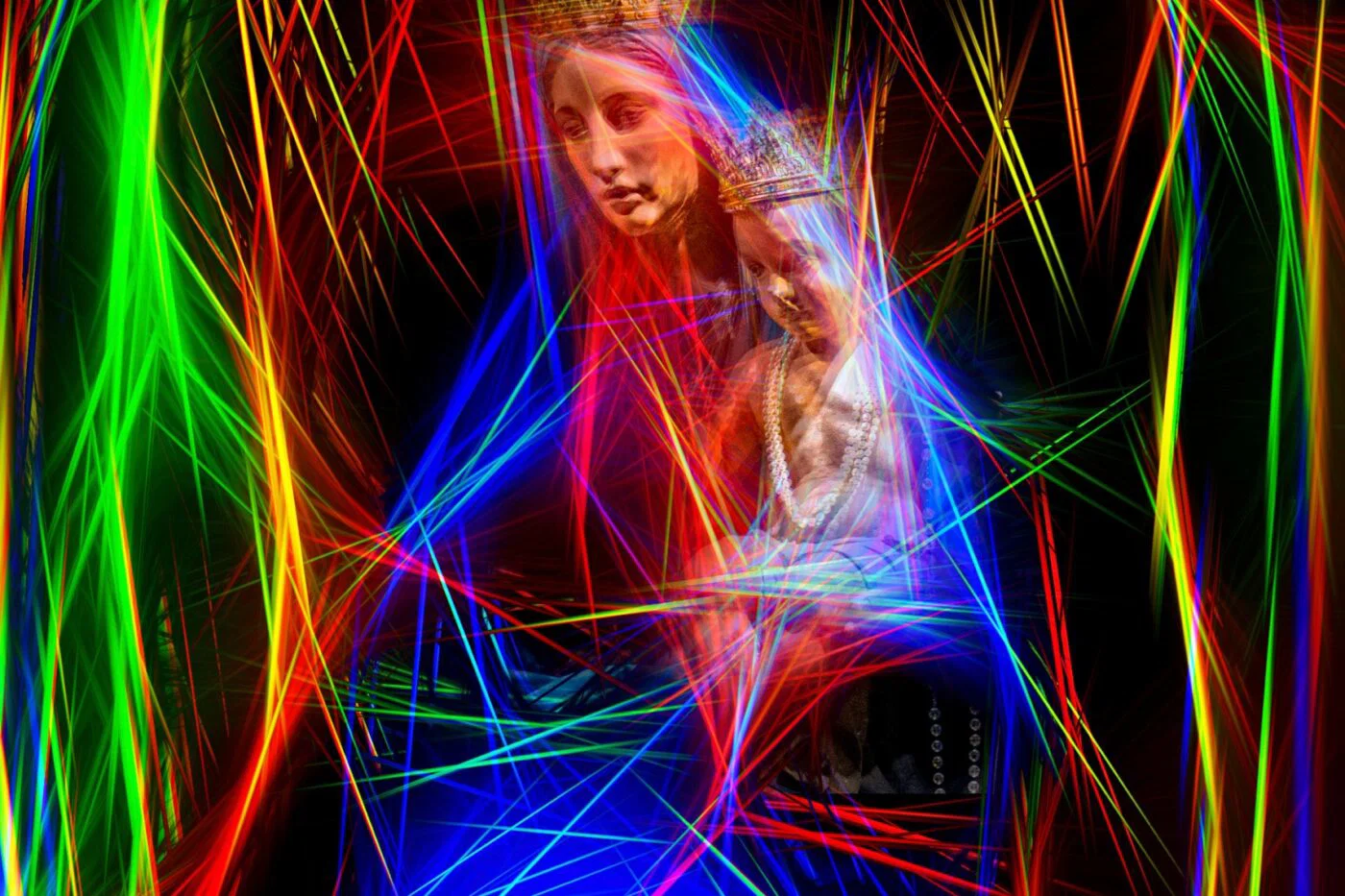
Look at Crowned Mary for three seconds.
Your gaze will not remain in one place. It rises toward the crown, descends to the face, discovers the child, and then follows the incandescent lines moving across the image. Red, blue, green, and yellow currents surround the figures, pass through them, and seem to continue beyond the frame.
That movement of the eye is not incidental. It is the beginning of the work.
Photography was invented to stop time. Howard Harris uses it to reveal that nothing ever truly stops.
Light travels. Bodies breathe. Molecules move. Buildings absorb the passage of people and years. Even when we attempt to stare at a single point, the eye makes minute movements that keep the world visible.
Stillness is convincing, but it is an illusion.
As a pioneer of Techspressionism, Harris has developed a visual language for the energy that exists beneath appearances. He does not merely photograph the object before him. He searches for the forces around it: light, motion, memory, emotion, vibration, and the invisible exchange occurring between the subject and the person looking.
His images begin with the visible world. They do not end there.
The Sacred Becomes Electric
Crowned Mary succeeds because recognition comes first.
We know this image. The Madonna and Child have traveled through centuries of paintings, sculptures, churches, private devotions, and collective memory. The downward gaze, the protective body, the crown, and the child resting close to the mother all belong to an established visual language.
Harris enters that history and energizes it.
The colored lines do not simply decorate the figures. They behave like currents. Some form an illuminated enclosure around Mary and the child. Others cross their bodies, interrupt their outlines, or shoot beyond them. The traditional halo has become a field of movement.
Yet the sacred image is not destroyed by the intervention. It becomes strangely alive.
The emotional power comes from the tension between permanence and motion. Mary appears ancient and futuristic, material and immaterial, present and remembered. She exists simultaneously as a religious figure, a cultural symbol, a mother, and an accumulation of light.
Harris makes visible something that religious art has always suggested: presence cannot be contained entirely by the physical body.
In Crowned Mary, energy becomes another form of devotion.
What Techspressionism Makes Possible
Techspressionism combines technological processes with the emotional and subjective force traditionally associated with Expressionism. Technology is not treated as the subject of the artwork or as a spectacle added after the photograph. It becomes an instrument through which the artist can expand perception.
For Harris, that expansion is deeply connected to his background in art, industrial design, and technology. A Denver native, he earned a BFA from the Kansas City Art Institute and a Master of Industrial Design from Pratt Institute, where he studied with influential design theorist Rowena Reed Kostellow.
His approach carries the discipline of a designer. He thinks about structure, visual hierarchy, material, movement, and the way an object changes through interaction.
In 2017, Harris received U.S. Patent No. 9,753,295 for a layered-artwork construction created to produce the illusion of depth and to change in color and spatial relationship as the viewer or the surrounding light changes.
In his dimensional works, photographic imagery can exist across a rigid base and translucent surfaces suspended above it. As the viewer moves, the relationship between those layers moves as well.
The artwork does not offer one definitive appearance. It contains possibilities.
This is an important distinction. Harris is not using technology to manufacture a superficial effect. His process reinforces the central idea within the work: perception is never fixed because the person looking is never fixed.
“Visual reality is an ever-shifting, highly individualized experience.”
Techspressionism gives that philosophy a physical form.
Architecture Is Not Silent
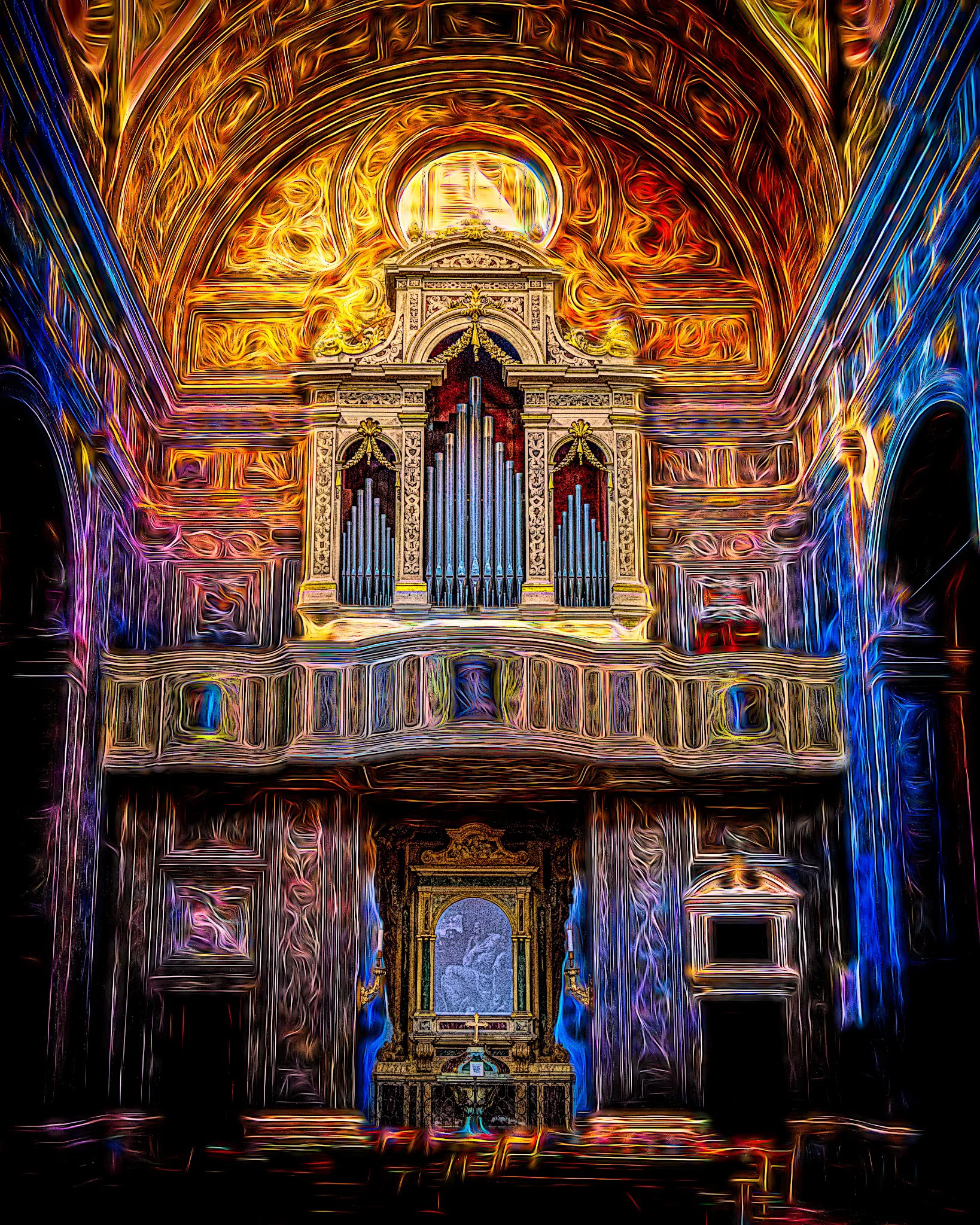
In Church of San Paolo in Ferrara, Harris transforms architecture into an organism.
The organ occupies the center like a rib cage, its silver pipes rising through a field of gold, red, violet, and electric blue. The walls appear to ripple around it. Arches flow into one another, ornament becomes motion, and the entire interior seems to breathe.
A conventional architectural photograph might document symmetry, scale, or historical detail. Harris searches for what documentation leaves behind.
He portrays the energy accumulated within the building: music once performed, voices once heard, ceremonies witnessed, footsteps repeated, prayers offered, and centuries of light crossing the same surfaces.
The church is not empty. It is saturated with what has passed through it.
This is one of the most compelling qualities of Harris’s work. He makes us question the assumption that an apparently motionless place is inactive. A building changes constantly. Light moves across its walls. Temperature expands and contracts its materials. Sound travels through its chambers. People enter, leave, remember, and return.
Harris does not illustrate those forces literally. He gives them a visual equivalent.
The architecture becomes less like a container and more like a living field.
The Energy of a Human Presence
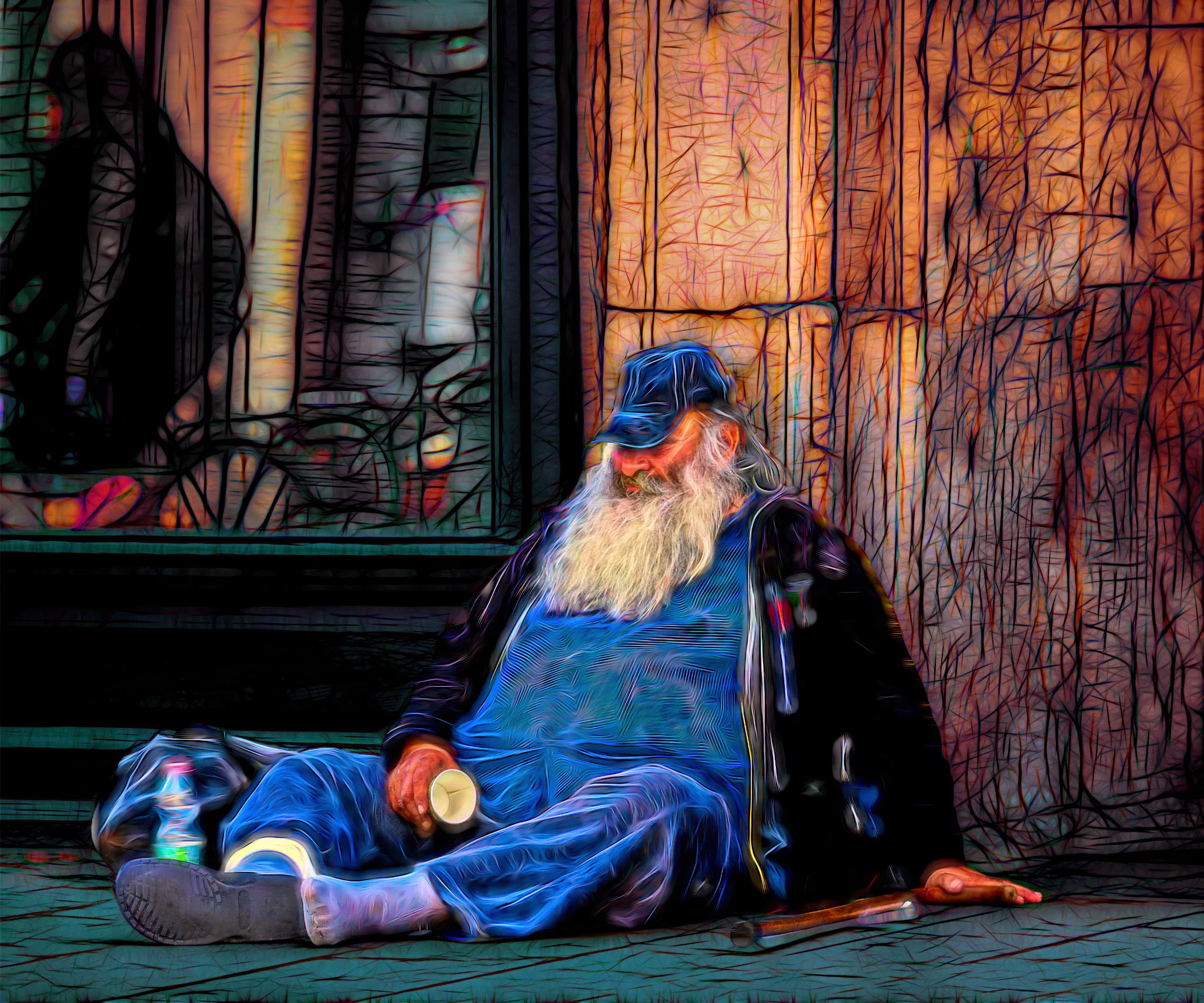
The movement in Just Waiting is quieter.
A man sits against a wall, his body carrying the visible weight of exhaustion. His cup rests in one hand. A cane lies near the other. Behind him, a dark figure appears in the window—perhaps another person, a reflection, or a presence created by the ambiguity of the scene.
The subject could easily be reduced to a social category: a homeless man, a forgotten man, a man waiting for help. Harris resists that reduction.
Color moves through his clothing and along the contours of his body. Blue gathers across his chest and legs. Light touches his beard. The wall behind him fractures into a network of lines, as though his presence has altered the atmosphere around him.
He is not portrayed as invisible.
He occupies the image with undeniable force.
The title, Just Waiting, creates its own uncertainty. What is he waiting for? Food? Change? Recognition? Another day? Or is the viewer the one being asked to wait—to remain with this person longer than the usual glance offered on a city street?
This is where Harris’s treatment of energy becomes profoundly human. Energy is not only spectacle, neon color, or physical movement. It is presence. It is the quiet force with which one life enters the consciousness of another.
The photograph asks us not simply to see the man, but to feel the space changed by his existence.
The Currents Between Us
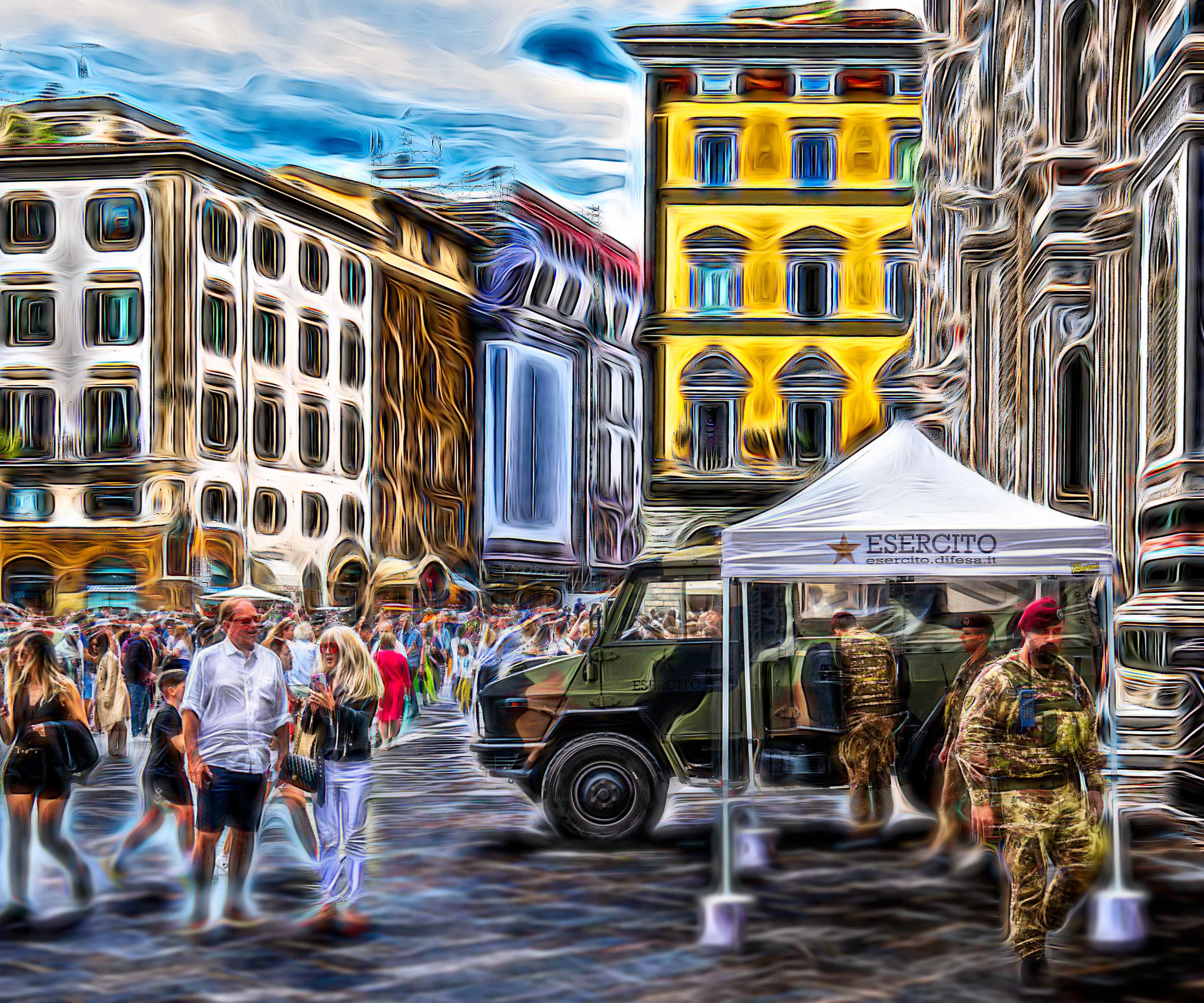
In Security, energy becomes collective and unsettled.
Civilians move through a public square while military personnel occupy the foreground. A vehicle, a white security tent, historic architecture, and a dense crowd compete for attention. The scene contains protection and unease, order and unpredictability, ordinary life and institutional power.
Harris’s treatment prevents the image from settling into a straightforward document. Buildings appear fluid. Figures blur into the movement of the street. Hard architectural edges bend and shimmer. The city feels as though it is responding to the human tension inside it.
The image raises a psychological question: does security make us feel safer because of what it prevents, or more anxious because of what its presence implies?
Harris offers no simple answer. Instead, he portrays the invisible exchange passing through the square—alertness, curiosity, authority, uncertainty, and the continuous negotiation of shared space.
Energy, here, is social.
It passes between strangers. It changes when uniforms enter the scene. It gathers around barriers, vehicles, crowds, and watching eyes. Although no single action dominates the photograph, the entire image feels charged.
Nothing is happening, and everything is happening.
The Viewer Completes the Circuit
Reader psychology often begins with recognition. The mind searches for something it knows: a face, a body, a building, a familiar symbol.
Harris gives us that point of entry—and then interrupts it.
Mary is recognizable, but she is surrounded by currents of light. A church is recognizable, but its architecture appears to breathe. A seated man is recognizable, but the atmosphere around him becomes part of his presence. A public square is recognizable, but its social tension seems to move through the buildings themselves.
The brain returns to the image because recognition has not fully resolved it.
That return is the second look.
It is also the moment when the viewer becomes part of the artwork. We bring our own memories, beliefs, fears, associations, and emotional states to what we see. The image has not physically changed, but our experience of it has.
This is the territory Harris has pursued throughout his work: the unstable boundary between external reality and internal perception.
He does not claim to photograph molecules or scientifically record invisible forces. He does something more personal. He gives constant movement a visual metaphor and invites us to become conscious of a truth we usually overlook.
The world is never waiting patiently to be observed.
It is moving while we look.
Learning to See an Unfinished World
The greatest achievement of Howard Harris’s Techspressionism is not that it makes photography look different. It makes the world outside the photograph feel different.
After spending time with these images, a church wall no longer seems completely motionless. A face carries more than its visible expression. A crowded street begins to reveal the currents passing between strangers. Light is no longer simply illumination; it becomes an active presence traveling through space.
Photography traditionally tells us: this happened, and the camera preserved it.
Harris proposes something more radical: this is still happening.
The energy continues. The light keeps moving. The meaning changes with every viewer. The image is not a conclusion but a living point of contact between matter, perception, technology, and consciousness.
Howard Harris does not ask us to believe in another world. He asks us to look more closely at this one.
Beneath every still surface, energy is traveling. Matter is vibrating. Light is moving. Nothing is static.
And in a Howard Harris image, nothing ever truly ends.
Sources
Howard Harris Fine Arts: artist statement and biography
Howard Harris Fine Arts: image construction
U.S. Patent No. 9,753,295: layered artwork
Howard Harris, artist-supplied DIXED editorial materials, January and May 2026.