The Art of the Second Look
John Nieman and the split second between recognition and surprise.
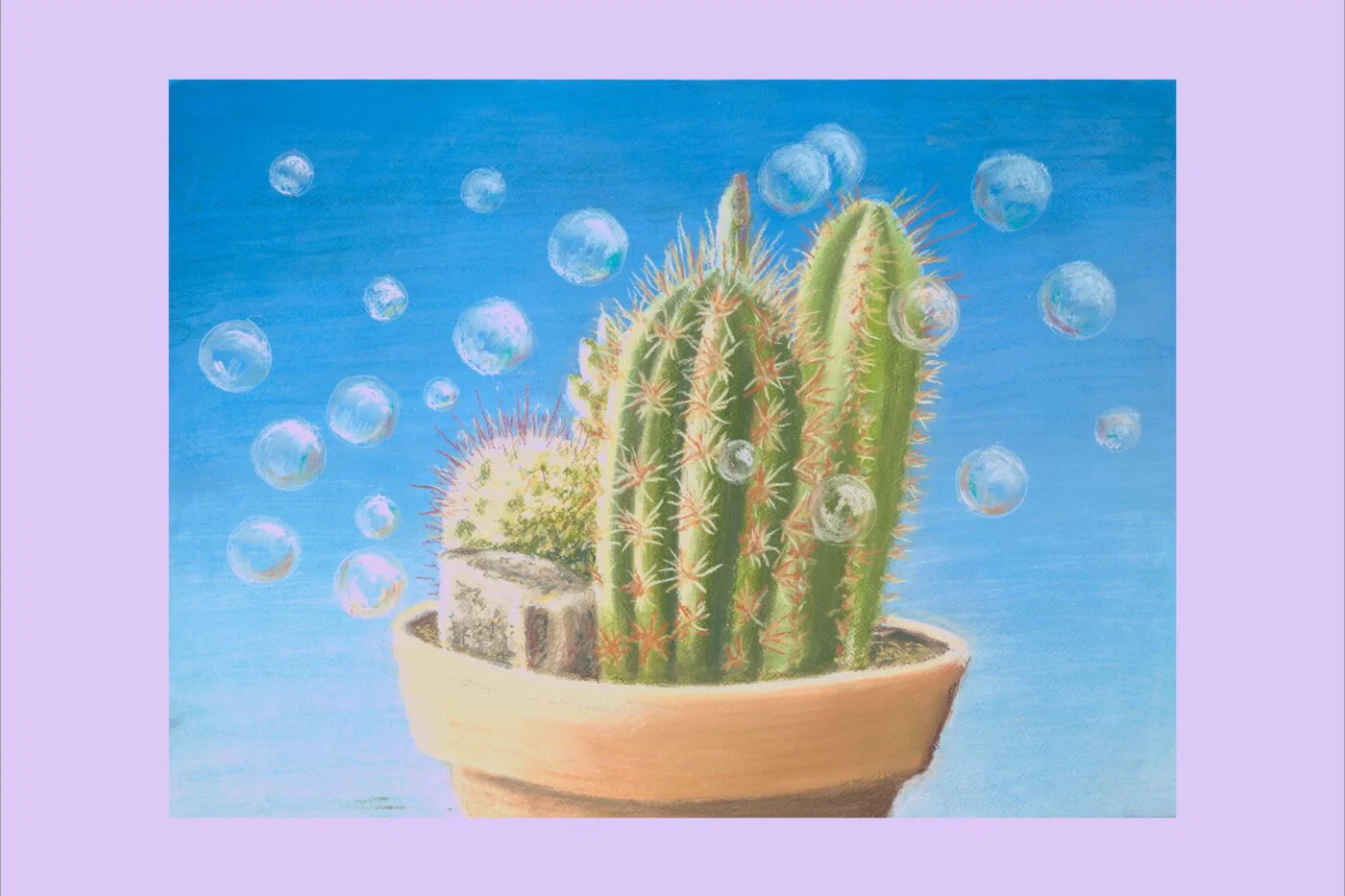
A cactus should not share its air with soap bubbles.
One bristles. The other vanishes. One has evolved to resist touch; the other can disappear because of it. Yet in John Nieman’s Cactus Bubbles, they occupy the same bright blue world.
The contradiction registers before we have time to explain it. First comes recognition: cactus, pot, sky, bubbles. Then comes the interruption. Why are these things together? Is the cactus being softened by its surroundings, or are the bubbles approaching something they cannot survive?
That brief hesitation is where Nieman’s art begins.
His paintings often operate in two beats. The first welcomes us with something familiar. The second unsettles the familiarity just enough to make us look again.
Recognition Is Only the Door
Nieman understands that recognition is one of the fastest ways into an image—but he does not allow it to become the final destination.
Everyday objects, flowers, sports fields, cultural references, words, and familiar symbols create an immediate point of entry. The viewer is never made to feel excluded from the work. There is no intellectual password required before the experience can begin.
But accessibility is not simplicity.
Once we enter, the relationships between the objects begin to shift. A visual joke becomes a question. A cheerful color acquires emotional weight. A line of text changes how we understand the space surrounding it.
The image appears open, but it contains a delay.
Nieman does not conceal meaning. He lets meaning arrive in installments.
The Gentle Collision
Cactus Bubbles is a perfect example of what makes this strategy so effective.
The plant is substantial and defensive. Its spines are drawn with enough attention that we can almost feel them. The bubbles are transparent, weightless, and temporary. They drift through the scene without recognizing the danger.
But the painting does not present the encounter as violent. Nothing has burst. Nothing has been wounded. The unlikely elements simply coexist.
That coexistence produces a more interesting question than conflict would: can toughness and delicacy inhabit the same life?
The cactus may represent protection, endurance, or the boundaries we develop over time. The bubbles suggest play, vulnerability, and the beautiful things we cannot hold. Nieman leaves enough space between these possibilities for the viewer’s own experience to enter.
The painting becomes personal without telling us what to feel.
When Concrete Blooms
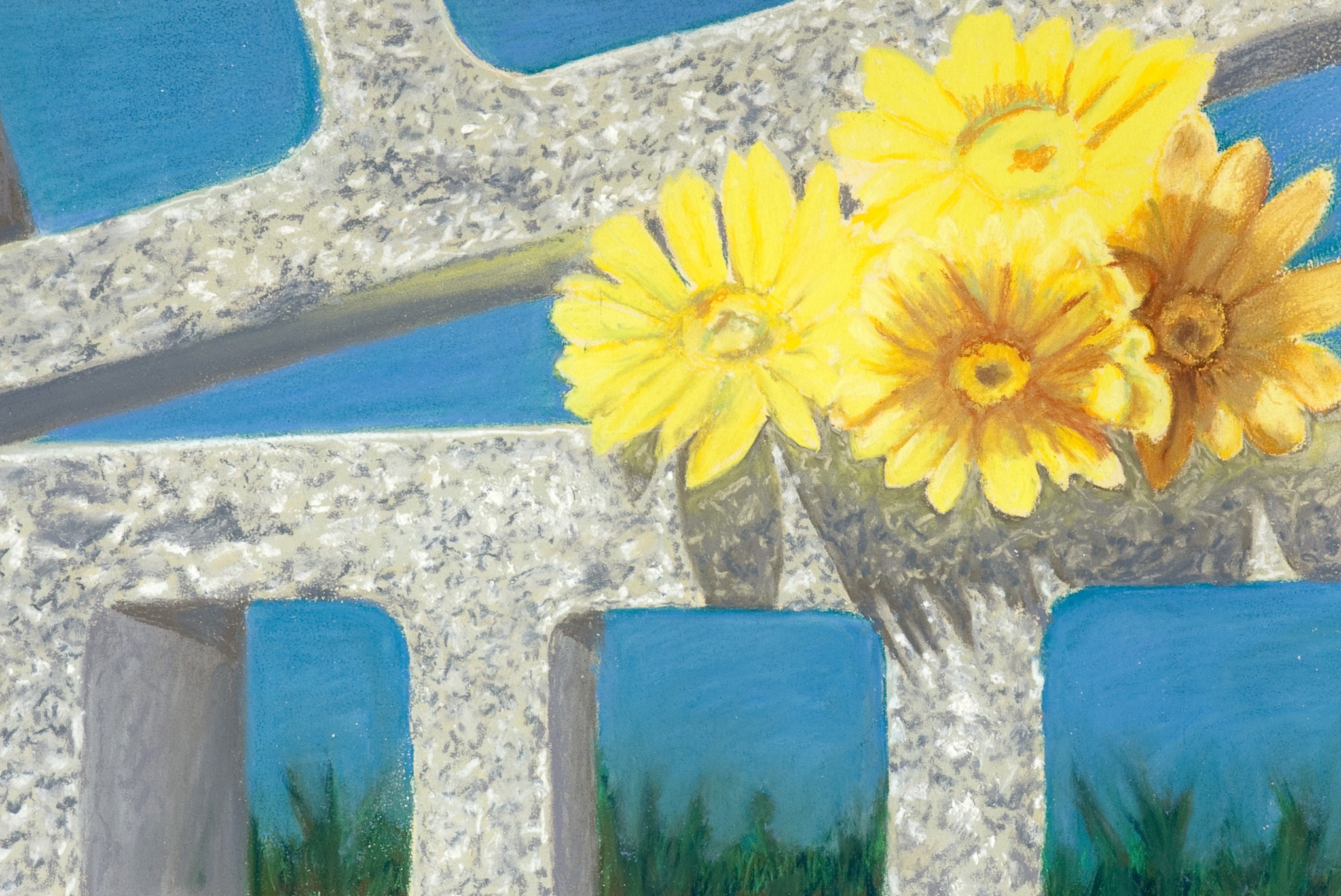
In Flower Power, a cluster of yellow flowers pushes into a composition dominated by heavy gray structures.
The flowers occupy only one area of the image, but they command it. Their yellow petals interrupt the architecture with warmth, irregularity, and life. The concrete appears permanent; the flowers are temporary. Yet it is the temporary element that captures our attention.
This reversal matters.
The work does not deny the weight of the built environment. It does not pretend that softness makes hardness disappear. Instead, it asks us to notice how a relatively small gesture of color can transform an entire field of gray.
The flowers are not simply decorative. They are an interruption—a living refusal to let the surrounding structure determine the whole mood of the image.
In Nieman’s world, visual power does not always belong to the largest object.
The Eloquence of What Is Missing
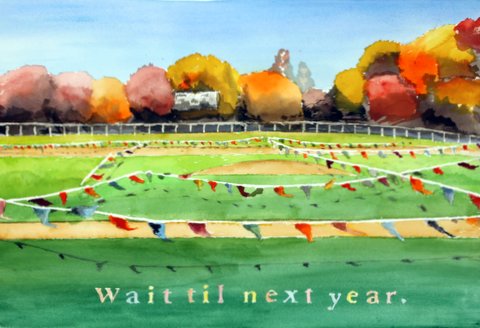
Wait Til Next Year gives us a different kind of interruption.
The racetrack is empty. Colorful pennants cross the grass, and autumn trees burn along the horizon, but the expected movement is absent. No horses. No crowd. No decisive moment.
Across the foreground, the title appears like a thought spoken after everyone else has gone home: Wait til next year.
The words do not explain the painting. They alter its sense of time.
Without them, we might be looking at a quiet sporting landscape. With them, the empty course becomes a place of disappointment, patience, memory, and renewed hope. Something did not happen—or did not happen as expected—but the story has not ended.
The painting understands a deeply human ritual: when the present fails us, we make an agreement with the future.
Perhaps next season. Perhaps next attempt. Perhaps next year.
Nieman turns absence into the central presence of the work.
A Creative Life Built on Timing
Nieman’s ability to control the sequence of attention is connected to a creative life that has crossed several disciplines.
His official biography describes experience as an international advertising creative director, music director, author, and chef. He has also written more than two dozen books and exhibited his art throughout the United States and Europe. His visual work frequently combines watercolor and pastel with crisp composition, saturated color, and strong contrast.
These different practices share something essential: timing.
Advertising must capture attention quickly. Music depends on anticipation and release. Writing controls what the reader learns—and when. Cooking depends on contrast, sequence, and the relationship between distinct elements.
In Nieman’s paintings, those instincts converge.
His advertising background appears not as commercial polish, but as an understanding of entry. He knows how to give the eye a clear place to begin. His work as a writer appears in the way a few carefully positioned words can redirect an entire image. His musical sensibility can be felt in the pause between the first impression and the second realization.
The painting becomes an event unfolding in time.
The Viewer Becomes the Final Author
Nieman has developed bodies of work around visual riddles, storytelling, music, and sport. Across these different approaches, words and images are frequently given equal responsibility.
The text is not a caption placed safely outside the artwork. It becomes an object within the composition—a hinge that allows the meaning to swing in another direction.
This asks more from the viewer than passive appreciation.
We must connect the image to the phrase. We must notice the contradiction. We must decide whether the humor is lighthearted, bittersweet, or quietly serious. Nieman gives us the necessary elements, but he does not complete every sentence for us.
The viewer supplies the final association.
That is why the work can feel immediately approachable and remain mentally active after the encounter. Its pleasure comes not from solving a puzzle correctly, but from recognizing that more than one answer can coexist.
What Remains After the Smile
There is humor in Nieman’s work, but humor is not its endpoint.
The smile is an opening. It lowers our defenses and makes room for a more intimate recognition: that endurance and vulnerability can coexist; that life can interrupt even the hardest structures; that an empty field can remain full of hope.
His paintings remind us that seeing is rarely completed in a single glance.
The familiar catches our attention. The unexpected holds it. What we bring from our own lives gives the image its final meaning.
After spending time with John Nieman’s work, the world itself begins to behave differently. Ordinary objects seem less settled. Words acquire new weight. Contradictions become invitations.
And the second look becomes the one that matters.
Sources
Artist-supplied DIXED submission materials, including artwork titles and caption information.
John Nieman: About the Artist
John Nieman: Recent Exhibitions
Viridian Artists: John Nieman—The Wanted Show